We take on tarmac driveway replacement right across Stocksbridge and its S35 and S36 postcodes, from Midhopestones and Bolsterstone to Wortley, plus nearby Penistone, Hoyland and Barnsley. We design each new drive in Stocksbridge to drain properly within the front-garden permeable-surface rules, and help with any dropped kerb application to Sheffield City Council.
Worn, crumbling or weed-ridden tarmac is something we are called out to right across Stocksbridge, and Stocksbridge Landscaping & Driveways replaces it with tarmac that is laid properly: dug out where the base has failed, resurfaced where it has not, and always finished hot, in two courses, against a solid edge. Tarmac driveway replacement is for any Stocksbridge homeowner whose drive has rippled where the car turns, broken away at the edges, sunk into hollows that hold water or faded to a grey, stony surface that sheds grit onto the pavement.
The first question is always whether the base is sound. A great deal of domestic tarmac was laid as a single thin course by travelling gangs, straight onto soil or an old concrete strip, and in those cases the only lasting answer is to dig it out and build a sub-base. Where the base is good and only the top has worn, resurfacing with a new surface course is quicker and much cheaper. We cut a test hole on the survey to find out which applies to you.
Every job comes with a written quote that shows the route we recommend and why, and a written guarantee on the finished drive.
Where We Offer Full Tarmac Driveway Replacement
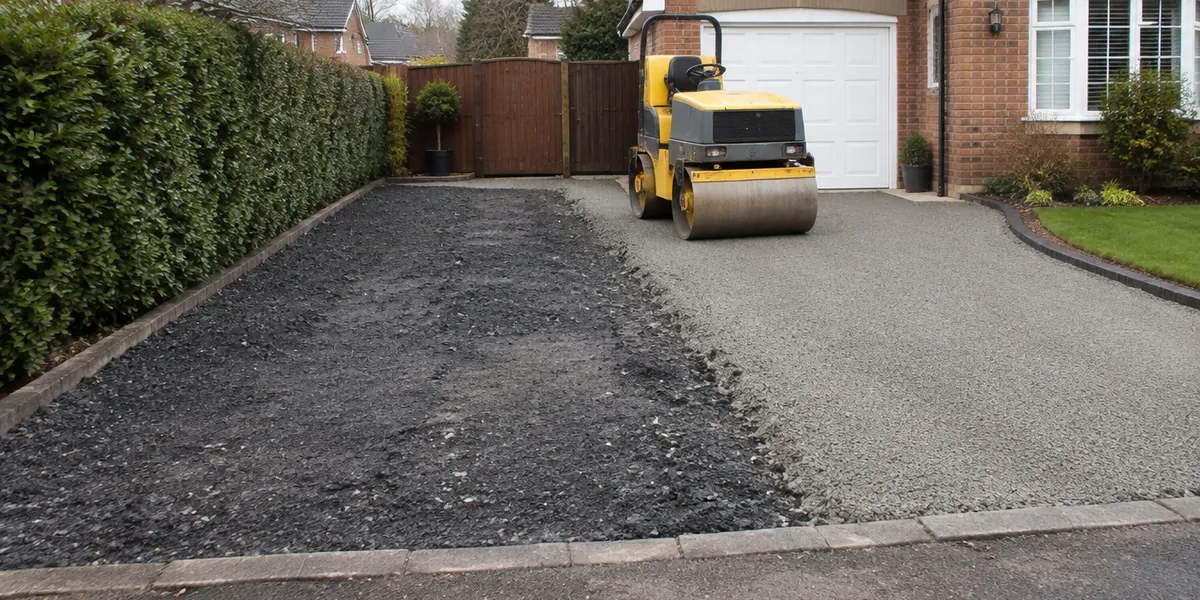
Full tarmac driveway replacement means removing the old tarmac and whatever is beneath it, building a new compacted sub-base with proper edge restraints and drainage, and laying a new two-course tarmac surface. It is the right choice when the existing drive has no real sub-base, when it has sunk or heaved, when the edges have broken away because nothing held them, when weeds are coming through from below, or when you want to widen the drive or switch to porous tarmac.
We dig out with a mini digger where access allows, loading the old tarmac into a grab lorry or skips for recycling, then excavating the soil or rubble beneath to around 250 mm below the new finished level. On a lot of Stocksbridge drives this reveals 30 mm of tarmac on garden soil.
The new base is 150 mm of Type 1 MOT compacted in two layers with a vibrating roller. Concrete kerbs, edging blocks or a block paving border are set on a concrete bed with haunching before any tarmac arrives, because tarmac without an edge to compact against always fails at the edge. Channel drains, gullies or a soakaway go in now if the old drive flooded. Then a 50 to 60 mm binder course of 20 mm dense bitumen macadam and a 25 to 30 mm surface course of 6 mm or 10 mm close-graded material, each laid hot and rolled.
What affects the result is the depth and compaction of the base, the edge restraint, laying while the material is hot and the thickness of each course.
Partial Tarmac Driveway Replacement
Partial tarmac driveway replacement, more often called resurfacing or overlay, replaces the worn surface course while keeping the existing base and binder in place. It is the right choice when the drive is level and firm, drains properly, has sound edges and simply looks tired, with the surface gone grey and stony or showing minor cracking. Many Stocksbridge drives laid properly twenty or more years ago fall into this category.
The survey decides it. We look for movement, soft spots, broken edges and standing water, and cut a small test hole to see how thick the existing courses are and what they sit on. If the base is good, resurfacing is on. If the drive flexes underfoot or the hole reveals soil, we recommend full replacement, because a new surface over a failing base lasts a couple of winters at best.
The work begins by cleaning the old surface, treating moss or weeds, and cutting out and patching any soft areas down to the binder course. Where the finished level must stay the same, at a garage threshold or a dropped kerb, we plane off the old surface course to make room. A bitumen tack coat is sprayed over the whole area so the new course bonds to the old, and a new 25 to 30 mm surface course is laid hot and rolled across the entire drive so there are no patches or seams.
Resurfacing is usually a one-day job and the drive can take a car within 48 hours. The result depends entirely on what lies beneath.
Why Stocksbridge Homeowners Choose Us for Tarmac Driveway Replacement
We have replaced a lot of bad tarmac in Stocksbridge, which has taught us where the shortcuts hide. Our drives are always laid in two courses, from a hot box, on a compacted stone base, against a concrete-haunched edge. Material comes from a local coating plant on the morning of laying and we keep the delivery tickets so you know what went down and at what temperature.
We are straight about resurfacing. It is a good option when the base is sound and we recommend it in those cases because it saves you money. We will not sell you an overlay on a failing base, because we would be back to replace it in two years and neither of us wants that.
Each job comes with a written quote listing the excavation or planing, base, edging, drainage and both tarmac courses, a written guarantee, legal disposal of the old tarmac through our registered waste carrier status, and the same team from survey to final roll. If a concrete driveway replacement or block paving would suit the house better, we will tell you.
Our Tarmac Driveway Replacement Process
- Survey and test hole. We inspect the surface, edges and drainage, cut a test hole to see the base and decide between full replacement and resurfacing.
- Written quote. You receive an itemised quote with the recommended route explained and a start date.
- Removal or preparation. For a full replacement the old tarmac and ground are dug out and taken away; for resurfacing the surface is cleaned, patched and planed where needed.
- Edge restraints. New kerbs, edgings or block borders are set in concrete, or existing edges are repaired.
- Base and drainage. Type 1 MOT is laid and compacted in layers, with drains or a soakaway installed, on a full replacement.
- Tarmac. The binder course and surface course, or the new surface course alone, are laid hot from the hot box and compacted with a roller while the material is workable.
- Handover. The site is cleared, we explain curing times and provide the guarantee paperwork.
A full tarmac driveway replacement in Stocksbridge takes two to four working days; resurfacing is normally completed in a single day.
What Affects the Cost of Tarmac Driveway Replacement in Stocksbridge
The biggest factor is whether the base needs rebuilding. Resurfacing involves little excavation, no new stone and one course of tarmac, so it sits well below a full replacement in cost. Full replacement is priced on the depth of dig, the amount of Type 1 and the two courses of tarmac, all of which scale with area.
Access shapes the labour. A drive that a mini digger and tipper can reach from the road is far quicker than one behind a narrow gate where everything is barrowed. The old surface matters too: thin tarmac lifts easily, but tarmac over old concrete means breaking out the concrete as well.
Edging, whether new concrete kerbs, edging blocks or a block paving border, drainage work, any widening of the drive, a pigmented or porous surface course and the disposal of the old material through recycling in Stocksbridge all add lines to the quote. We set each of them out so you can see what you are paying for.
Tarmac Driveway Replacement Around Stocksbridge
Poorly laid tarmac can turn up on any street, so we replace it everywhere in Stocksbridge. In Midhopestones and Wortley, if a thin single course laid years ago has crumbled at the edges, we dig it out and do it properly. If your frontage in Deepcar is small and the base is sound, a quick resurfacing may be enough, and on a larger drive in Bolsterstone we can rebuild and widen at the same time. If your home in Ewden came with developer tarmac, we usually replace it with a full two-course drive or porous tarmac. We cover all of these and nearby Penistone, Hoyland and Barnsley.
Customers in Stocksbridge often ask us about block paving driveway replacement at the same time.
Your Questions Answered
How can I tell if my tarmac driveway needs a full replacement or just resurfacing?
Walk the drive after heavy rain. Standing water, ripples where the car turns, edges that have crumbled away, soft spots that give underfoot and weeds growing through the middle all point to a failed base and a full replacement. A drive that is firm and level but looks grey, stony and tired is usually a candidate for resurfacing. We confirm with a test hole.
Can new tarmac be laid over old tarmac?
Yes, when the old tarmac is firmly bonded to a sound base. The surface is cleaned, soft spots are patched, a tack coat is applied and a new surface course is laid over the top. Where levels must be kept, the old surface is planed off first. Over a cracked, sunken or soil-based drive, overlaying simply postpones replacement.
What happens to the old tarmac?
It is taken to a licensed recycling facility under our registered waste carrier status, where it is crushed and reused as road planings or recycled tarmac. Nothing goes to landfill. Where a drive in Stocksbridge is being planed for resurfacing, the planings can sometimes be reused on site as a base for a path or shed.
Will a new tarmac driveway need planning permission?
Replacing an existing tarmac drive like for like does not need permission. If you enlarge it beyond 5 m² at the front of the house with a dense, impermeable surface, rainwater must drain within your boundary or permission is required. Porous tarmac counts as permeable and avoids the issue. We check conservation area rules in Stocksbridge too.
How soon can I use the new drive?
In cool weather a car can go on after 24 to 48 hours. In summer the surface stays soft for longer and we suggest three to four days. For the first few weeks avoid turning the steering while stationary, parking on the same spot every day and resting jacks, stands or skips on the surface, as the bitumen is still hardening.