If you live in Bolsterstone, Midhopestones or anywhere else in Stocksbridge, we can quote for block paving driveway replacement; we also cover nearby Penistone, Hoyland and Barnsley. We design each new drive in Stocksbridge to drain properly within the front-garden permeable-surface rules, and help with any dropped kerb application to Sheffield City Council.
A block paved drive that has sunk into ruts, spread at the edges or heaved into a hump is not a sign that block paving was the wrong choice. It is almost always a sign that the base underneath was never built properly. Stocksbridge Landscaping & Driveways carries out block paving driveway replacement across Stocksbridge, lifting the old blocks, rebuilding the sub-base and edges to BS 7533 and either relaying the original blocks or laying new ones. We work for homeowners in Stocksbridge whose drives have become uneven, hold water or have simply dated, and for anyone with natural stone setts worth saving.
Replacing block paving is a different job from replacing concrete or tarmac, because the surface comes apart. Blocks in good condition can be lifted, cleaned, stacked and relaid, which keeps the cost down and the character of the house intact. Where blocks are worn, broken or no longer to your taste, we take them away and lay new ones in a colour and pattern you choose.
Either way the point of the exercise is the base. We give a written quote that sets out the lifting, base work and relaying separately, and a written guarantee on the rebuilt drive.
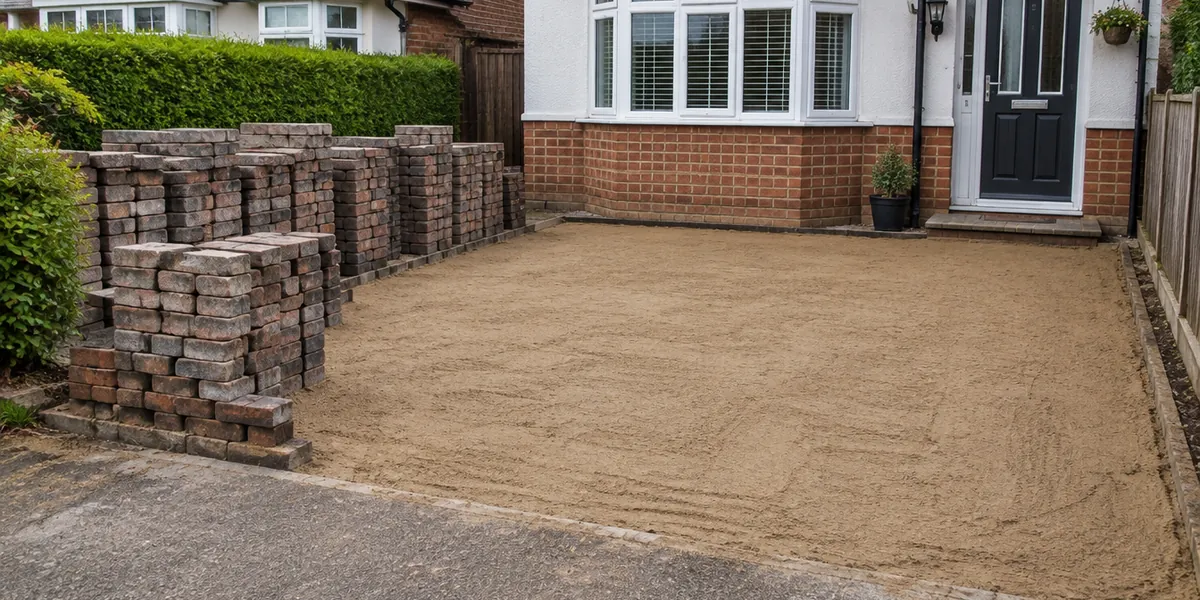
Concrete Block Paving Replacement
Concrete block paving replacement covers the lifting and relaying, or the removal and renewal, of a drive laid in manufactured concrete blocks. It is the right choice when the drive has sunk along the tyre tracks, when blocks have spread or rocked because the edge course has given way, when the surface pools water or has become a trip hazard, or when the blocks themselves have worn, faded, cracked or stained beyond cleaning.
If the blocks are sound we relay them. The jointing sand is loosened, the blocks are lifted by hand or with a block lifter, stacked on pallets and cleaned of old sand and moss. If they are past saving, new blocks are ordered, and we bring samples to Stocksbridge so you can see them against the brickwork.
With the surface gone, the failure is usually obvious: often 50 mm of sand over soil, or loose hardcore that was never compacted. The old bedding and inadequate sub-base are dug out, a geotextile is laid on clay ground, and 150 mm of Type 1 MOT is compacted in layers. Edge courses that sat on dabs of mortar are rebuilt on a full concrete bed with haunching. Drainage is added if water was a problem.
The blocks then go down on a screeded 30 to 40 mm sand bed in a herringbone bond, are cut in at the edges, compacted with a rubber-matted plate and jointed with kiln-dried sand in two passes. The result depends on compaction, the screed and the new edge restraints.
Natural Stone Driveway Replacement
Natural stone driveway replacement is the rebuilding of a drive laid in granite, sandstone, limestone or basalt setts and cobbles. It is the right choice when the stone has sunk or spread, when mortar joints have failed and the setts have loosened, when the drive has become too uneven to walk on safely, or when good stone was laid badly and has never looked right.
Lifting is done by hand. Each sett is prised up, the old mortar or sand is knocked off, and the stones are sorted by size and thickness so they can be laid in courses that sit true. Broken setts are replaced with matching stone in the same type and finish. Where the original stone is too thin to reuse, we advise on new stone that suits the house, as we have for many period properties.
The new base is at least 150 mm of compacted Type 1 with concrete-set edge restraints. Calibrated setts of even thickness can be laid flexibly on sand like a concrete block. Riven or hand-cut setts that vary in depth are better bedded on a semi-dry mortar over a bound base, each stone tapped down to a straightedge, and the joints filled afterwards with a brush-in resin compound or slurry grout. That gives a rigid, weed-resistant surface that will not work loose again.
What affects the result is the patience of the sorting and setting, the consistency of the bed and the quality of the jointing. Stone is slower than concrete block work, and it is where skilled hands show.
What You Get When We Handle Your Block Paving Driveway Replacement
Lifting and relaying block paving is sometimes sold as a quick fix: sweep the sand out, lift the dipped area, add a bit of sand, put the blocks back. It levels the drive for a season and then the same dip returns, because the base beneath has not changed. We rebuild the base, which is what BS 7533 asks for and what the drive needed in the first place.
Our team has lifted and relaid block drives all over Stocksbridge. We know how to recover blocks without breaking them, how to clean them so they relay cleanly and how to blend in a few new blocks when some are beyond saving. For natural stone we sort, set and joint by hand and take the time it requires.
You receive a written quote that separates lifting, base reconstruction, edging, drainage and relaying or new blocks, a written guarantee on the rebuilt drive, removal of any discarded material through our registered waste carrier status and honest advice if a concrete driveway replacement or tarmac would be a better use of the budget.
How Our Block Paving Driveway Replacement Works
- Survey. We assess the condition of the blocks, the cause of the sinking or spreading, the edge courses and the drainage, and discuss relaying versus new blocks.
- Written quote. An itemised quote covers lifting, base work, edgings, drainage, bedding and relaying or new paving, with a programme.
- Lifting. The jointing sand is loosened and blocks or setts are lifted, cleaned, sorted and stacked on pallets, with damaged units set aside.
- Excavation. Old bedding sand and any inadequate sub-base are dug out to the depth the new base needs, and the formation is checked.
- Base and edges. A membrane is laid where needed, Type 1 MOT is compacted in layers and new edge restraints are set on a concrete bed with haunching.
- Relaying. A screeded sand bed, or a mortar bed for riven stone, is laid and the blocks or setts are relaid in the chosen pattern, cut in at the edges and checked for level.
- Compaction and jointing. Flexible paving is vibrated and sand-jointed in two passes; rigid stone is resin- or slurry-jointed. The site is cleared and the guarantee handed over.
A block paving driveway replacement in Stocksbridge usually takes four to seven working days, with natural stone taking longer because of the hand setting.
Block Paving Driveway Replacement in Stocksbridge: What Changes the Price
Relaying the existing blocks or buying new is the first fork. Reusing sound blocks saves on materials but adds labour for lifting, cleaning and sorting. New blocks range from plain concrete rectangles through tumbled and permeable blocks to clay and natural stone, with price rising accordingly.
The condition of the base sets the excavation and stone required. A drive with a thin but genuine sub-base needs topping up and compacting; one on soil needs a full 150 mm of Type 1 from scratch. Rebuilding failed edge courses on concrete, adding drainage, recessing manhole covers and correcting levels against a garage or the public footway are each priced on their own.
Pattern complexity, borders and circle features add cutting time. Natural stone sits well above concrete block for labour because of the sorting, mortar bedding and resin jointing. Access for pallets and a mini digger, and disposal of any discarded blocks and old bedding, round off the quote for a Stocksbridge drive.
Block Paving Driveway Replacement Throughout Stocksbridge
Block paving laid during the 1980s and 1990s boom is now reaching the age where the base problems show, and in Bolsterstone and Midhopestones we lift and relay drives like that on a weekly basis. If your front garden in Deepcar is small, a rebuilt block drive with a permeable finish solves standing water as well as levels. If you share a drive with a neighbour in Wortley, both halves need rebuilding to the same line, and in Ewden, where a developer has laid block paving over a thin base, we rebuild it properly. We also cover nearby Penistone, Hoyland and Barnsley, and any period house across Stocksbridge with natural stone worth saving.
Other work we carry out across Stocksbridge include tarmac driveway replacement.
Your Questions Answered
Can my existing blocks be reused?
In most cases, yes. Concrete blocks that are not cracked, badly worn or crumbling at the edges can be lifted, cleaned and relaid on a new base, and natural stone almost always can. Expect a small percentage to break on lifting, which we replace with matching blocks. Faded colour is cosmetic and relaying in the same pattern hides it well.
Why has my block paving sunk in the tyre tracks?
Because the sub-base under the drive is too thin or was never compacted, so the repeated load of the car has pushed it down along the same two lines. Relaying the blocks with more sand only hides it briefly. The lasting fix, which is what we do in Stocksbridge, is to lift the blocks, rebuild and compact a proper Type 1 base and relay them.
Will the relaid drive look different?
If the original blocks are reused in the same pattern it will look like your old drive, but level and with firm edges. Blocks that were under a parked car may be slightly darker than those exposed to sun, and the odd replacement block will be new, though the differences blend within a season of weathering.
Can I make the drive permeable when it is replaced?
Yes. Replacing the blocks with permeable concrete paving laid over an open-graded stone base, with grit-filled joints, turns the drive into a SuDS-compliant surface that soaks up rain. It is a popular choice in Stocksbridge for drives that have flooded the pavement, and it removes the need for planning permission on a larger front drive.
How long does block paving driveway replacement take?
A typical concrete block drive takes four to seven working days to lift, rebuild and relay, and can be driven on as soon as the jointing is complete. Natural stone bedded on mortar takes longer, both for the hand setting and for a few days of curing before a car goes on. We confirm the programme with your written quote.