We take on gravel driveway maintenance right across Stocksbridge and its S35 and S36 postcodes, from Wortley and Bolsterstone to Ewden, plus nearby Penistone, Hoyland and Barnsley. We check the base and the drainage on every Stocksbridge drive we price, because the surface is rarely the whole story.
A gravel driveway is the easiest surface to maintain and the easiest to neglect. Stocksbridge Landscaping & Driveways grades, tops up and recompacts gravel drives for homeowners across Stocksbridge, from short shingle drives at the front of a semi to long rural tracks. The work is for anyone whose gravel has thinned in the wheel tracks, drifted into the lawn, grown weeds or developed the ruts and puddles that make a drive uncomfortable to use.
Gravel moves. Every time a car turns, the tyres push stone sideways and backwards, so the tracks empty and the edges pile up. Rain carries fines down the slope and leaves hollows that hold water. Leaves rot into the surface and give weeds a seedbed. None of this is a failure of the drive; it is simply what loose stone does, and an hour or two of the right work each year puts it back.
Our two main services are grading, which redistributes and levels the existing gravel and adds more where needed, and recompaction, which firms the sub-base and surface so the stone stops migrating. Both are explained below, along with how we work and what affects the cost in Stocksbridge.
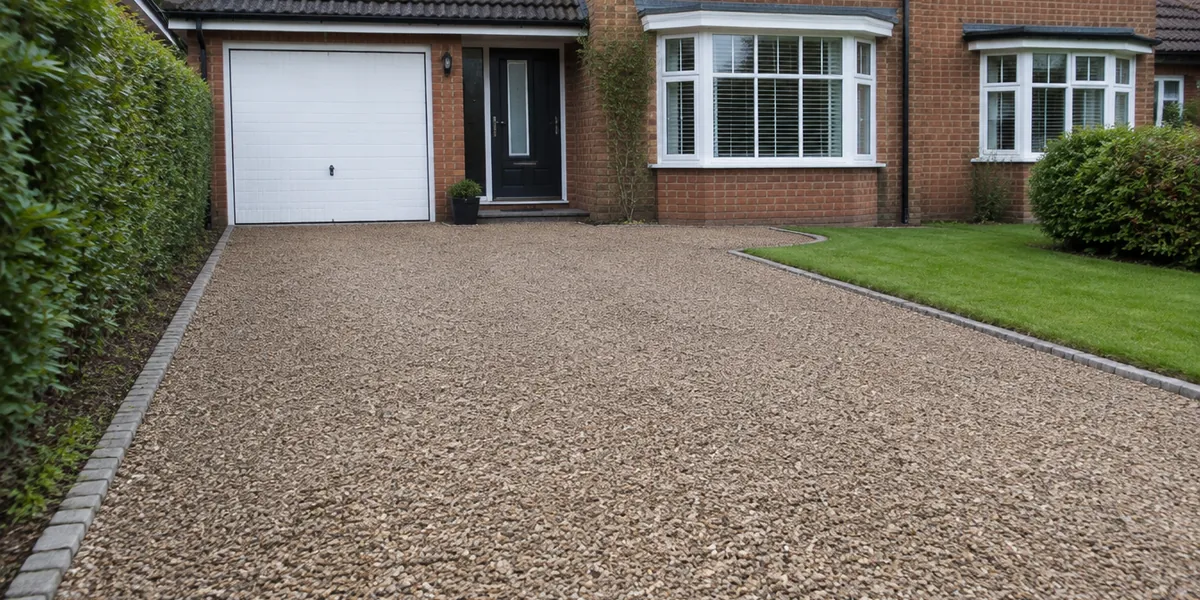
Gravel Driveway Grading
Grading means pulling the gravel back to an even depth across the whole drive. On most gravel drives in Stocksbridge the stone ends up in two ridges along the edges and a bare strip down each wheel track. We rake it back from the edges, fill the tracks and hollows, and top up with fresh stone where there is not enough to go round. The aim is around 30 to 50 millimetres over a firm base, enough to hide the base without being so deep that tyres sink and spin.
It is the right choice when the drive is rutted, puddling or looking thin, but the base underneath is still sound. If mud is coming up through the stone after rain, grading is only a temporary fix and recompaction is the real answer.
A small drive is graded by hand with landscape rakes and a barrow of matching gravel. Larger drives get a towed grading rake, which combs the stone level and breaks up the crust in the tracks. We remove leaf litter and weeds first and check any gravel grid or geotextile for tears. We then add new gravel of the same type and size, usually 10 or 20 millimetre angular stone or pea shingle, and rake it through so the new blends with the old.
Worn stone, failed edging and poor drainage all affect the result. A gravel drive is a permeable surface, which keeps it on the right side of the front-garden planning rules, but only if water can actually get through it.
Gravel Driveway Recompaction
Recompaction firms up the layers beneath the loose stone. A properly built gravel drive sits on a compacted Type 1 MOT sub-base, often with a geotextile membrane underneath and sometimes a plastic gravel grid on top. Over the years that base softens: water gets in, frost lifts it, heavy vehicles push it down in the tracks. Once it is soft, the stone sinks into the hollows as fast as you fill them.
It is the right choice for drives in Stocksbridge that rut again within weeks of grading, drives with soft or muddy patches, and drives that have had a skip or lorry on them. It also suits older drives laid as gravel straight onto soil, which we can firm up without a full rebuild.
We scrape the loose gravel back to one side and expose the base. Soft spots are dug out, filled with fresh Type 1 and compacted in layers of no more than 100 millimetres with a vibrating plate or, on long drives, a roller. We correct the falls so water sheds to a soakaway, a gully or a border rather than towards the house. Where there is no membrane we lay one to stop the base mixing with the soil. The gravel is then raked back over, topped up and compacted lightly so it beds in without being crushed.
The size of the drive and the depth of the problem shape the job. Pea shingle never truly locks together; angular stone compacts better and is what we recommend when adding new material.
Why Stocksbridge Homeowners Choose Us for Gravel Driveway Maintenance
Gravel is often treated as a cheap surface that anyone can look after, and in the simple cases that is true. Where we earn our money in Stocksbridge is on the drives that keep going wrong: the ones that rut, puddle or shed stone onto the road, because something underneath is not right. We build gravel driveways from the sub-base up, so we can tell quickly whether a rake and a top-up will do or whether the base needs attention.
We match the stone. Turning up with a different size or colour of gravel leaves a patchwork, so we identify what you have and source the same. We hold a waste carrier registration for the weeds, leaf litter and spoil we take away, we carry insurance for the plant we use and every job starts with a written quote.
If you are weighing up gravel against other options, we also carry out Driveway Cleaning and Driveway Sealing on hard surfaces, so our advice is not tied to one material.
Our Gravel Driveway Maintenance Process
- Assessment: we walk the drive after rain if we can, looking for ruts, puddles, soft spots, weed growth and failed edging.
- Clearing: leaves, weeds and debris are removed, and persistent weeds are treated at the root.
- Base inspection: gravel is pulled back in problem areas so we can see the sub-base and any membrane or grid.
- Base repair: soft areas are dug out, refilled with Type 1 in layers and compacted, and falls are corrected towards drainage.
- Grading: existing gravel is raked level and fresh matching stone is added to bring the depth up.
- Compaction: the surface is lightly plated so the stone settles without crushing.
- Edging check: timber, metal or block edging is reset where it has moved, so the stone stays on the drive.
A short drive in Stocksbridge is usually done in half a day. A long drive with base repairs can take two or three days, and we try to schedule it in a dry spell so the base compacts properly.
What Affects the Cost of Gravel Driveway Maintenance in Stocksbridge
Length and area come first. Gravel is bought by the tonne and a long drive in Stocksbridge can need several loads to bring it back up to depth, while a short frontage might need less than a bulk bag.
The condition of the base is the next factor. Simple grading is quick; cutting out soft areas, bringing in Type 1 and compacting in layers is a bigger job with more material and plant time.
Access for deliveries matters. A tipper that can back onto the drive saves hours of barrowing compared with a bag dropped on the road. Stone type affects material cost, with decorative gravels and washed stone costing more than crushed limestone or granite. Extras such as laying a membrane, fitting a gravel grid, resetting edging or adding a soakaway are listed separately on your written quote so you can decide what to include.
Gravel Driveway Maintenance Throughout Stocksbridge
Our gravel work covers all of Stocksbridge and nearby Penistone, Hoyland and Barnsley. If you have a longer gravel drive in Deepcar or Bolsterstone, grading and base repair after a wet winter is usually what it needs. In Midhopestones we top up and tidy a lot of short shingle frontages each spring. Where a drive in Wortley sits on heavy clay, the base tends to go soft and need recompaction, and in Ewden we fit gravel grids to stop stone spilling onto the pavement. Wherever you are in Stocksbridge, we can usually quote from a few photographs and a measurement.
Other work we carry out across Stocksbridge include driveway maintenance.
Common Questions
How often should a gravel driveway be topped up?
Most gravel drives in Stocksbridge need a rake and a light top-up every year or two, and a proper grade every few years. Drives with a gravel grid lose far less stone and go longer between top-ups. If you are adding gravel every few months, the base is probably the problem and recompaction will save you money in the long run.
Why does my gravel drive keep rutting?
Ruts form where tyres push stone sideways and the base underneath gives way. If grading fixes it for a season and then the ruts return, the sub-base is soft or too thin. Digging out the tracks, refilling with compacted Type 1 and relaying the gravel, ideally with a grid, stops the cycle.
What depth of gravel should a driveway have?
Around 30 to 50 millimetres of loose stone over a compacted base is the usual target. Shallower than that and the base shows through in the tracks; deeper and tyres sink and spin, especially with rounded pea shingle. With a gravel grid, the stone sits in the cells at a controlled depth and stays put much better.
Can you stop weeds growing in my gravel drive?
We remove existing weeds and treat the roots, and we lay or repair a geotextile membrane under the gravel where there is not one. That stops weeds coming up from below. Seeds blowing in from above will still germinate in trapped leaf litter, so an occasional rake and sweep keeps them manageable.
Does a gravel driveway need planning permission in Stocksbridge?
Gravel is a permeable surface, so laying or maintaining one in a front garden usually falls within permitted development even where it exceeds 5 square metres. Exceptions can apply in conservation areas or for listed buildings, and dropped kerbs are a separate matter with the council. We can point you in the right direction when we quote.