From our base in Stocksbridge (S36) we handle block paving joint maintenance in Ewden (S36), Midhopestones (S36), Wortley (S35) and nearby Penistone, Hoyland and Barnsley. We check the base and the drainage on every Stocksbridge drive we price, because the surface is rarely the whole story.
The joints are the part of a block paved driveway that fail first. Stocksbridge Landscaping & Driveways refills, replaces and renews the sand between paving blocks for homeowners across Stocksbridge whose drives have started to grow weeds, attract ants or feel loose underfoot. Joint maintenance is a cheap, quick job compared with relaying, and done every few years it keeps a block paved drive solid for decades.
Here is why it matters. Block paving is a flexible surface. The blocks sit on a bed of sharp sand over a compacted Type 1 sub-base and are held in place by the jointing sand between them, which locks them together under load, following the BS 7533 approach to flexible paving. When rain, ants, pressure washers and weed roots take that sand out, the blocks can move, the edges rock and water gets into the bedding layer. From there the drive starts to sink in wheel tracks and the repair cost climbs.
We offer two ways to put the joints right: plain kiln-dried sand replenishment and polymeric sand renewal, which hardens once wetted. Both are explained below, with our process and the factors that affect the price in Stocksbridge.
Where We Offer Jointing Sand Replenishment
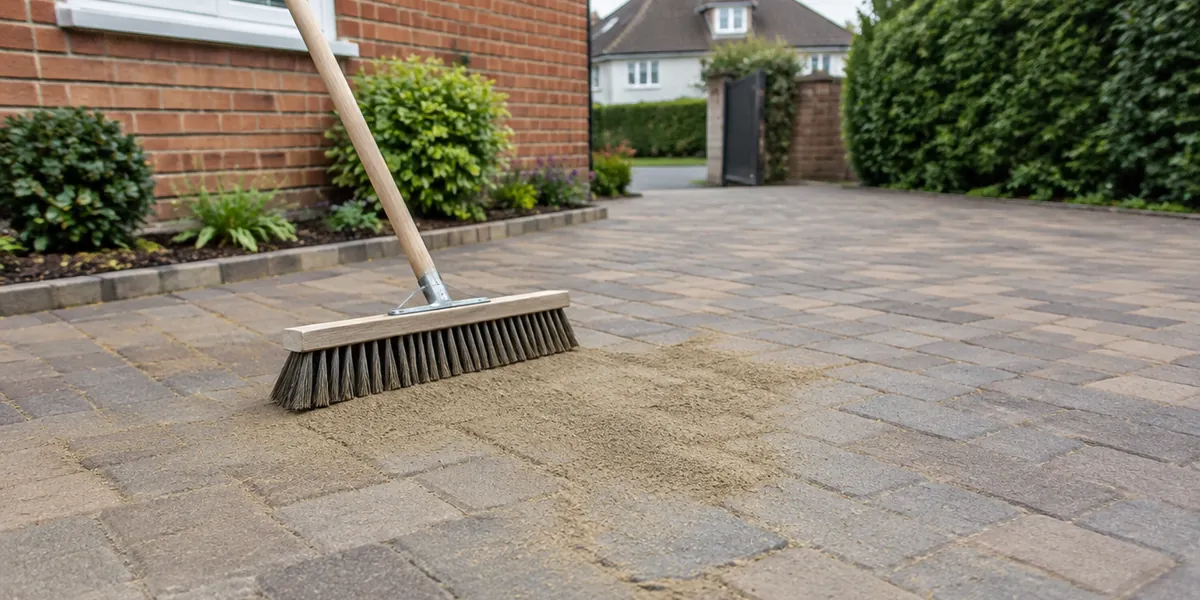
Jointing sand replenishment is the basic maintenance every block paved drive in Stocksbridge needs. The sand swept into the joints when the drive was laid works its way out over time. Rain washes it from sloping drives, ants mine it out and leave heaps on the surface, and a careless pressure wash can empty a joint in seconds. We top the joints back up with kiln-dried sand, a bone-dry silica sand that flows into a joint only a few millimetres wide.
It is the right choice when the blocks are still level and the joints are simply low or empty. If the blocks click when you walk across them, you need this done soon. It also follows every clean we do, because washing a drive always lifts some sand out.
The drive must be dry, so we pick a dry day or wait a few days after a clean. Weeds and moss are removed from the joints with a scraper or weed burner. The sand is spread across the surface and brushed diagonally into the joints with a soft broom, then a plate compactor with a rubber mat vibrates it down. We brush and compact again until the joints will take no more, then sweep the surface clean.
The width and depth of the joints and how well the edge restraints are holding affect the outcome. Narrow, deep joints hold sand well; wide, shallow ones lose it faster, and we will say if Driveway Sealing is the better long-term answer for your drive.
Polymeric Sand Renewal
Polymeric sand is kiln-dried sand mixed with a binder that sets when wetted. Brushed into the joints dry, compacted and then lightly watered, it cures into a firm but slightly flexible joint that weeds cannot root in, ants cannot dig and rain cannot wash out. For homeowners in Stocksbridge who are tired of re-sanding every spring, it is the step up from plain jointing sand.
It is the right choice for drives with persistent weed growth, for sloping drives that lose sand every winter, and for anyone who wants to pressure wash in future without emptying the joints. It needs joints a few millimetres wide and a sound, level drive; it will not hold blocks rocking on a failed sub-base.
Renewal means replacing what is already there. We rake or jet out the old sand to at least two-thirds of the block depth, remove all weed roots and moss, and let the joints dry completely. The polymeric sand is brushed in, compacted, brushed again and compacted again. Every grain is blown off the surface with a leaf blower before watering, because any left on the blocks will set there and leave a haze. We then mist the surface in two or three light passes so the water soaks down without flooding the sand out.
The result depends on preparation and weather above all else. The joints must be full and dry, the surface clean and there must be no rain for 24 hours afterwards. We choose a colour to match the blocks, usually buff or grey.
Why Stocksbridge Homeowners Choose Us for Block Paving Joint Maintenance
We lay block paving in Stocksbridge, so when we look at a drive with empty joints we are also checking the things that cause them: edge restraints that have moved, kerbs that have dropped, wheel tracks that are starting to sink. Topping up the sand on a drive that is failing underneath is a waste of your money, and we would rather tell you that at the quote stage.
We use kiln-dried sand, never damp building sand that cakes on the surface and will not flow into the joint. Our plate compactor has a rubber mat so it settles the sand without chipping the block faces. For polymeric work we follow the product instructions on joint depth and watering, which is where most failed polymeric jobs go wrong.
Written quotes, insurance and a registered waste carrier for the weed and old sand we take away come as standard. We can pair joint maintenance with Driveway Cleaning or sealing on the same visit to save you a second call-out.
How Our Block Paving Joint Maintenance Works
- Inspection: we check joint depth, look for loose blocks and failed edges and decide with you between plain sand and polymeric.
- Weed and moss removal: joints are scraped, burned or treated so nothing is left to grow back through the new sand.
- Cleaning: if the drive needs it, a pressure wash follows, and the drive is left to dry for several days.
- Joint clearance: for polymeric renewal, old sand is raked or jetted out to the required depth.
- Filling and compacting: sand is brushed in diagonally and vibrated down with a plate compactor, repeated until full.
- Finishing: the surface is swept or blown clean, and polymeric sand is misted to activate it.
- Hand-over: we tell you how long to keep cars and foot traffic off and when to expect the first rain to be safe.
Plain re-sanding on a typical drive in Stocksbridge takes a few hours. Polymeric renewal is usually a full day, sometimes two if the drive needs cleaning and drying first.
What Affects the Cost of Block Paving Joint Maintenance in Stocksbridge
The size of the drive and the width of the joints decide how much sand goes in. A drive with wide joints between tumbled or rumbled blocks takes several times the sand of one with tight-jointed rectangular blocks.
The choice between kiln-dried and polymeric sand is the biggest cost difference. Polymeric sand costs considerably more per bag, and the preparation, cleaning out the old joints and drying the drive, takes longer.
Condition adds to the job. Heavy weed growth, moss in every joint or a drive that needs a full pressure wash before re-sanding all add time. Loose blocks that need lifting and re-bedding are quoted as a repair. Where joints have been filled before with mortar or a failed polymeric product, cutting that out is slower than clearing sand. We set all of this out on a written quote for every job in Stocksbridge.
Block Paving Joint Maintenance Around Stocksbridge
We maintain block paving joints all over Stocksbridge and nearby Penistone, Hoyland and Barnsley. If your drive in Deepcar slopes, it will lose sand every winter, and polymeric jointing is usually the answer. In Bolsterstone and Midhopestones we do a steady run of re-sanding after spring cleans, and it is worth booking the two together. If ants are lifting the joints on your drive in Wortley, which happens most on sandy ground, polymeric sand stops them, and in Ewden we often combine joint renewal with sealing. Any address in Stocksbridge is within easy reach for a quote.
Customers in Stocksbridge often ask us about driveway maintenance and driveway sealing at the same time.
Frequently Asked Questions
How often does block paving need re-sanding?
Plain kiln-dried sand usually needs topping up every one to three years, sooner on sloping drives or after a pressure wash. Polymeric sand lasts considerably longer because it sets hard and resists washing out. Sealing the drive after re-sanding extends the interval further. We can advise on your drive in Stocksbridge when we see it.
Can I just sweep sand into the joints myself?
You can top up small areas with kiln-dried sand and a soft brush, but without a plate compactor the sand sits loosely at the top and washes out again. Weeds also need removing from the joints first. For a whole drive, or for polymeric sand, proper compaction and preparation make the difference between a job that lasts and one that does not.
What is the difference between kiln-dried and polymeric sand?
Kiln-dried sand is plain dry silica sand that locks blocks together by friction. Polymeric sand is the same sand with a binder that sets firm when watered, so it resists weeds, ants and rain. Kiln-dried is cheaper and quick to apply; polymeric costs more but lasts much longer and allows pressure washing later.
Will polymeric sand stop weeds completely?
It stops weeds rooting in the joints, which is where almost all of them grow on block paving. Seeds landing on the surface can still sprout in dirt that collects on top, but they pull out easily because they have no root in the joint. Keeping the drive swept and clean prevents most of that.
My blocks are rocking; will re-sanding fix that?
Usually not on its own. Rocking blocks mean the bedding layer or the edge restraint has failed, and new sand will not hold them. We lift the loose blocks, re-bed them on fresh sharp sand, reset any moving edge kerb, then re-sand the whole area. We will tell you which it is when we survey the drive in Stocksbridge.