We offer ground cover installation across the whole of Stocksbridge, including Ewden, Midhopestones and Wortley, as well as nearby Penistone, Hoyland and Barnsley. Every job starts with a free site visit in Stocksbridge, where we measure up, check access and talk through options before sending a written quote.
Ground cover installation from Stocksbridge Landscaping & Driveways covers everything that sits on the surface of a bed to suppress weeds, hold moisture and finish the look. Our team installs living ground cover plants, organic mulches and decorative gravel for homeowners across Stocksbridge, on new borders we have just planted and on established gardens that have become a weeding chore. It is for anyone who wants their beds to look after themselves for most of the year.
Bare soil does not stay bare. In Stocksbridge's climate it grows weeds within a couple of weeks, dries into a crust in summer and splashes onto paving in winter. Covering it with plants, bark or stone cuts the weeding to minutes a month and keeps the roots beneath cool and damp.
Three services make up this page. Living ground cover planting uses low, spreading plants to carpet the soil. Organic mulch installation lays bark, woodchip or compost to a working depth. Decorative gravel installation puts down a membrane, a levelled base and a stone finish with a proper edge. We prepare the ground thoroughly first, because no covering works on a bed full of perennial weeds, and the work carries our written guarantee.
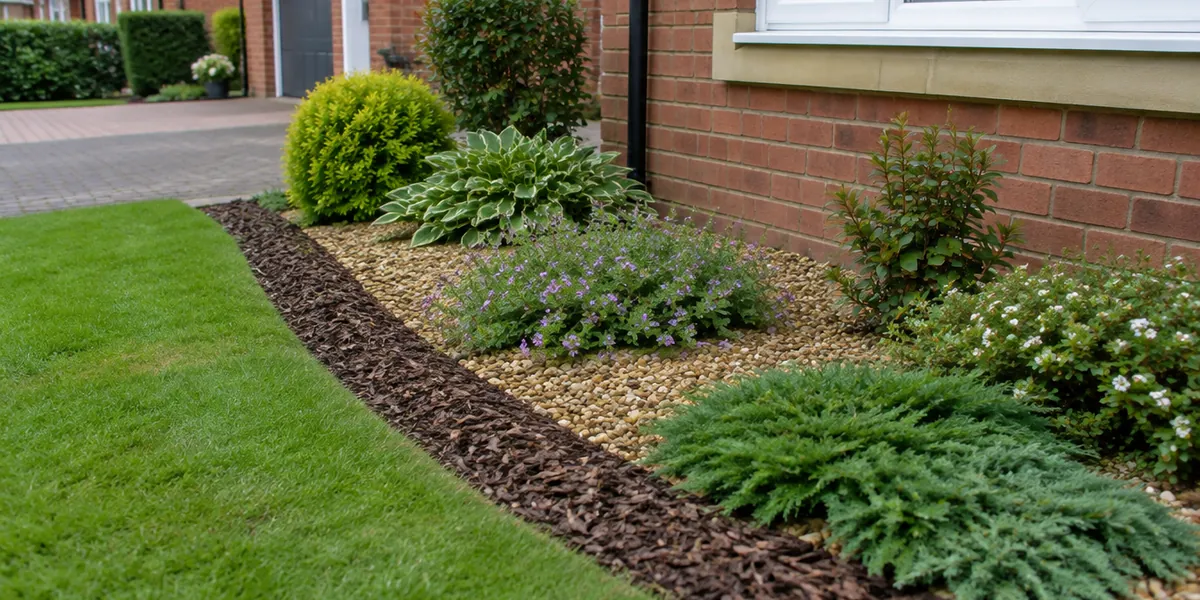
Living Ground Cover Planting
Living ground cover planting uses low, spreading plants to cover the soil between shrubs, under trees and on banks where grass will not grow or cannot be mown. It is the right choice when you want a green finish that changes with the seasons, when a slope needs holding together, or when shade under trees has defeated every lawn attempt.
Plant choice follows the light and the soil. In dry shade under trees we use geranium macrorrhizum, epimedium, pachysandra and ivy cultivars. In damp shade it is ferns, lamium and brunnera. On sunny banks and gravel edges, creeping thyme, sedum, stachys and hardy geraniums do the work. Vinca and ajuga cope with almost anything and are our standby for awkward corners in Stocksbridge.
Density is what makes it work. We plant at five to nine per square metre depending on the species, usually from 9 cm pots, so the plants knit together within two seasons and leave no gap for weeds. Before planting, every perennial weed is removed by the root, the bed dug over and given a light dressing of compost. A thin bark mulch between the young plants keeps the soil clean until the cover closes.
Once established, living ground cover needs little beyond an annual tidy and the occasional pulling of a weed that has blown in on top. It is the best long-term answer for shady ground in Stocksbridge, and it looks better every year rather than needing a top-up.
Organic Mulch Installation
Organic mulch installation is the spreading of a layer of composted bark, woodchip, garden compost or well-rotted manure over the soil surface of a bed. It is the right choice for almost every planted border, for the base of hedges and trees, and for any garden where weeding and watering have become the main jobs. Organic mulch also feeds the soil as it rots down and improves the structure of heavy clay soils.
The depth is the key figure. Less than 50 mm lets weeds through and dries out quickly; we lay 50 to 75 mm across planted beds and up to 100 mm in a circle round young trees, kept a few centimetres clear of stems and trunks so it does not cause rot. We mulch onto damp soil, in spring after rain or in autumn before the ground cools, because a mulch laid on dry soil keeps water out rather than in.
Material depends on the use. Composted bark is the standard for ornamental borders: it looks tidy and lasts two to three years. Woodchip is cheaper and suits woodland areas and hedge bases. Garden compost or well-rotted manure is the best feed for vegetable beds and hungry borders but needs replacing yearly. We avoid fresh woodchip on borders because it draws nitrogen from the soil as it rots.
Before any mulch goes down, the bed is weeded thoroughly and edged. Most clients in Stocksbridge book a top-up every spring to keep the layer at working depth.
Decorative Gravel Installation
Decorative gravel installation lays stone over a membrane and a prepared base, finished with a firm edge. It is the right choice for paths, drought-tolerant borders, low-maintenance front gardens and the strips beside a house where nothing grows. It is also a permeable surface, which matters for front gardens in Stocksbridge where the 5 m² impermeable paving limit applies.
Preparation decides whether gravel stays tidy or turns into a weed bed. We strip turf and topsoil to around 100 mm, remove roots and perennial weeds, level and compact the base, and for paths or anywhere that takes a barrow we lay and compact 50 mm of Type 1 MOT. A woven membrane goes over the base, lapped and pinned, with planting holes cut where plants are part of the scheme. For wheeled traffic, a honeycomb gravel grid on top stops the stone migrating and rutting.
Gravel size and colour are matched to the use. A 10 mm gravel is comfortable to walk on and sits well around plants; 20 mm is better for paths and parking strips because it stays put. Golden flint, limestone chips, slate and grey granite are the usual choices. Depth is 40 to 50 mm, enough to hide the membrane without becoming hard to walk on.
Edging holds it all together. We use treated timber, steel, brick on edge or a block paving kerb set in mortar, depending on the look and the paving next to it. A gravel area with no edge spreads onto the lawn within a season, so we never leave one open.
Why Stocksbridge Homeowners Choose Us for Ground Cover Installation
Ground cover only works on a clean, prepared bed, and that is the part most people skip. We weed by the root, so bindweed, ground elder and couch grass do not come straight back through the bark. On gravel areas we strip to a firm base and lay a proper membrane, so the stone stays clean for years.
We know the depths and densities that work in Stocksbridge's conditions: 50 to 75 mm of bark, 40 to 50 mm of gravel, five to nine ground cover plants per square metre. We know which plants cope with dry shade under a mature tree and which need the damp side of the garden. Guesswork leaves a bed half covered and full of weeds in its second year.
Packaging and spoil are removed under our registered waste carrier licence. The work comes with a written quote and a written guarantee, and the same team handles our garden installation and tree and shrub planting services, so a new border can be planted, mulched and edged in one visit.
How Our Ground Cover Installation Works
- Site visit. We look at the beds, the light, the existing weeds and the access, and discuss plants, mulch or gravel for each area.
- Measuring and specification. Areas are measured, depths and materials chosen, and plant densities set for any living cover.
- Written quote. Materials by the bulk bag, plants by the pot, membrane, edging and labour, all itemised.
- Clearance and preparation. Weeds dug out by the root, beds edged, gravel areas stripped, levelled and compacted.
- Membrane and edging. Weed membrane laid and pinned where gravel is going, with edging fixed before any stone goes down.
- Planting and laying. Ground cover planted and watered, mulch or gravel barrowed in and raked to an even depth.
- Handover. A tidy site with waste removed, and simple notes on watering new plants and topping up mulch.
Most ground cover jobs in Stocksbridge take one to three days. Mulching is best done in spring or autumn on damp soil; gravel can be laid in any dry spell; living ground cover goes in during autumn or spring.
What Affects the Cost of Ground Cover Installation in Stocksbridge
Area is the main driver. Mulch and gravel are bought by the bulk bag and the number of bags rises directly with square metres and depth. A path at 50 mm needs more stone than a border dressed at 40 mm, and a tree circle at 100 mm of bark needs double the mulch of a standard bed.
The material chosen matters. Composted bark costs more than woodchip; slate and granite chips cost more than a local flint gravel. For living ground cover, the species, pot size and planting density set the plant bill, and shade-tolerant plants are often slower to produce and priced accordingly.
Preparation is where labour varies most. A bed riddled with bindweed takes far longer to clear than one mulched last year. Gravel on soft ground needs a Type 1 MOT base; areas taking vehicles need a grid. Steel or brick edging costs more than timber.
Access across Stocksbridge gardens ranges from a lorry at the kerb to twenty barrow runs through a side gate. Each factor appears as its own line in the written quote.
Ground Cover Installation Across Stocksbridge
We lay mulch, gravel and living ground cover across the whole of Stocksbridge. Gravel front gardens are in demand in Wortley and Ewden, where they give parking and planting without the need for planning permission. If mature trees in Deepcar or Bolsterstone leave your garden with areas of dry shade, living ground cover handles them better than any lawn. Around Midhopestones we mulch a lot of new borders each spring to help young plants through their first summer. From our base in Stocksbridge we cover all of these and nearby Penistone, Hoyland and Barnsley.
Planning more than one job? Have a look at landscape installation.
Your Questions Answered
Does gravel need a weed membrane?
Yes, for anything other than a planted gravel garden on poor soil. A woven membrane over a levelled, weed-free base stops soil mixing with the stone and keeps most weeds out. Seeds that blow in on top still germinate occasionally, but they pull out easily because they cannot root through the membrane.
How often does bark mulch need topping up?
Composted bark lasts two to three years before it breaks down to the point where weeds come through, but most clients in Stocksbridge prefer a lighter annual top-up each spring to keep the depth at 50 mm or more and the border looking fresh. Garden compost and manure mulches need replacing every year.
Will ground cover plants take over the garden?
Some can if left unchecked. Vinca, ivy and lamium spread readily and are best used where they can be contained by paving or a lawn edge. For beds mixed with other plants we choose clump-forming species like geranium macrorrhizum, epimedium and stachys that cover well without running. We match the plant to the space.
Can I park on a gravel area?
Yes if it is built for it. A parking area needs a compacted Type 1 MOT base, a membrane and a honeycomb gravel grid filled with 20 mm angular stone, so the gravel does not rut or spread under tyres. It is also a permeable surface, which keeps a Stocksbridge front garden within the planning rules.
Which is better under trees, mulch or ground cover plants?
Both have their place. Bark mulch is the right choice around a young tree for its first three years. Under an established tree, living ground cover suited to dry shade gives a better long-term finish and does not need topping up. We often plant ground cover through a thin bark mulch so the bed looks tidy while the plants fill in.